

THE PREPPY HANDBOOK
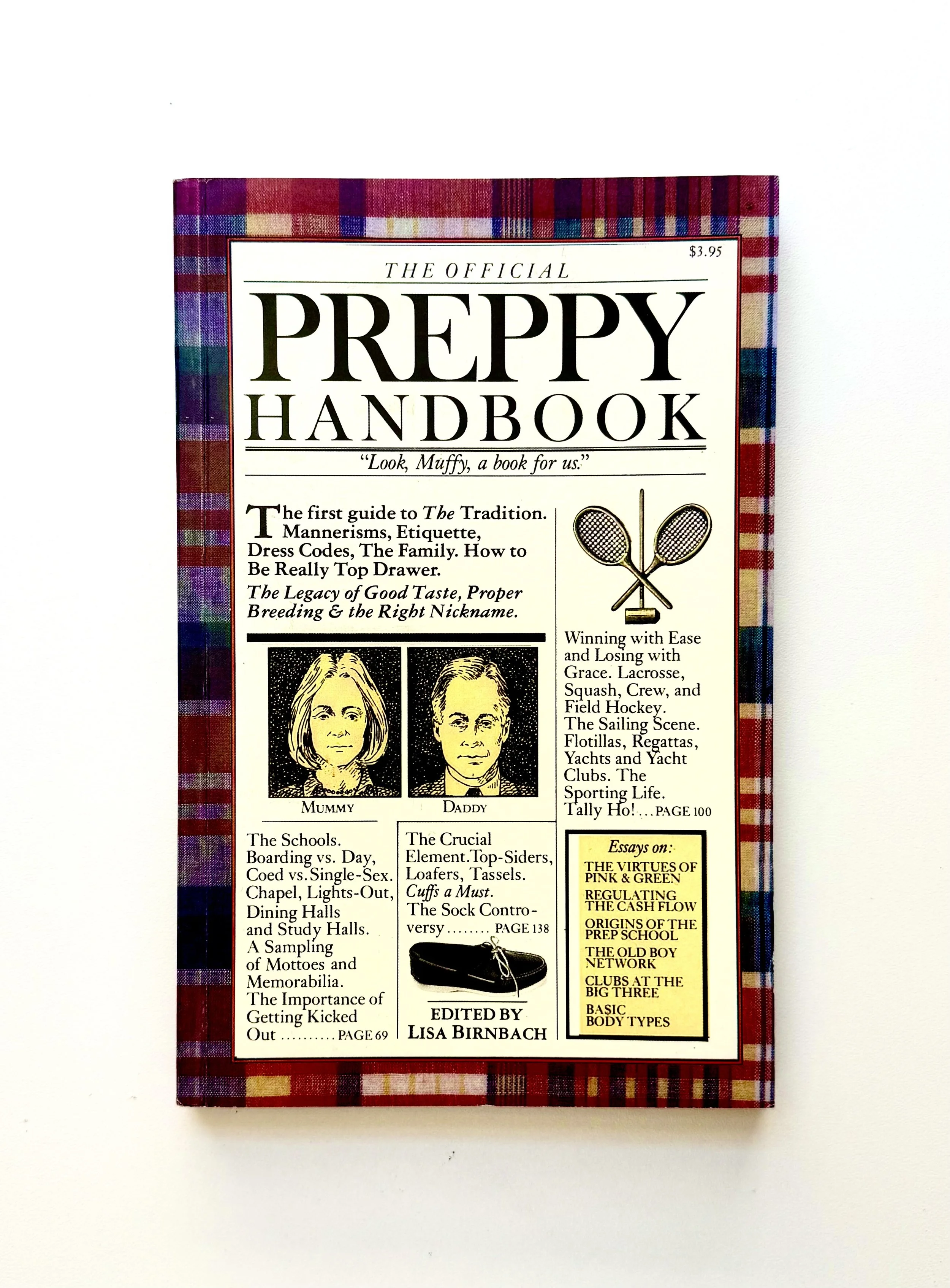
Photo by Peter J. Cooper
In the Montecito Country Mart in Montecito, California is a little eclectic collectibles store called Mate Gallery, which I call the best little store in the country. You can find vintage decorative items and books, barware, ephemera, California flags, and vintage clothing like OP corduroy shorts. This store is so cool, it even has special collabs with RRL and L.L. Bean. When I was there, I gravitated toward a copy of the paperback classic The Official Preppy Handbook, written by Lisa Birnbach, that was sitting on the shelf next to a stack of old paperbacks of the bestselling novel Jaws. When I commented on the book to the manager, I was told I just missed Birnbach by a couple of days as she had wandered into the store and found the same book I was flipping through – expressing her excitement in seeing it on a shelf for the first time in years.
Edited by Birnbach and co-authored with Jonathan Roberts, Carol McD. Wallace, and Mason Wiley, and published by Workman Publishing in 1980, the handbook is presented as a serious guide to everything preppy while lampooning the codes and social constructs of prep school alumni and old-money families. It was published when I was in middle school, and as an avid reader of Mad Magazine and National Lampoon, and a huge fan of film and television comedies of similar humor, I had always suspected the Preppy Handbook was heavily influenced by the 1978 film National Lampoon’s Animal House. Based on one of the writer’s experiences at Dartmouth College, not only is Animal House preppy to its core, but I’d also go so far as to say the film actually launched the preppy movement, which is beautifully manifested in the Preppy Handbook. Just look at the Delta’s style – cotton chinos, oxfords, polos, penny loafers without socks, cable knit sweaters, rep ties and navy blazers, and toggle coats – paired with their irreverent behavior where drinking heavily, throwing toga parties and gatoring are essential. All one has to do is examine the backstory of Otter, Hoover, Boone, and Pinto, and then look forward to what their futures hold for them and you have yourself the bones of the handbook. And I think Lisa Birnbach understood this perfectly. She absolutely nailed it in her book, which sold over a million copies, topping bestseller lists for months.
The handbook's humor shines through its tone, parodying preppy life from cradle to grave with advice like where to shop, or what a preppy weekend looks like, or how to "summer" properly or host cocktail parties without vulgarity. Complementing the text are Oliver Williams' whimsical illustrations: cartoons of loafers worn without socks, pearl-necklaced debutantes, and khaki-clad dads, evoking the Animal House vibe with captions that amplify the parody. The visual humor – the preppy archetypes in absurd scenarios - helped the book feel like a genuinely fun field guide, which would later influence magazine layouts and style aesthetics throughout all media. The handbook provided directories of prep schools and colleges, and the dos and don’ts of how to get into the schools, humorously advising on applications while introducing the public to their hedonistic underbellies. It gave nationwide guidance how to dress the part, on what clubs to join, where to eat and drink, and where preppies vacationed. It even discusses what vehicles to drive in the prepmobile section.
Throughout the 80s era, you could see the explosive effect the Preppy Handbook had on our culture. In Houston, the Polo Shop opened and became the pinnacle of all-things preppy and it still is today but now it’s simply called Ralph Lauren. Leslie & Company was our store for items not found in the Polo Shop, like grosgrain belts and watch straps, argyle socks, and shirts and belts with ducks on them. The store remains today but now it’s for women only. The L.L. Bean catalog was an important reference for ordering essential items for school, as was the Banana Republic catalog before they opened their safari-themed stores. J. Crew launched and quickly became identifiable with a go-to catalog for the preppy look – everything in there was all cotton and cool. In movies, you could see the preppy style in films like Class, Sixteen Candles, Making the Grade, St. Elmo’s Fire and Dead Poets Society.
As a kid on his way to prep school, I saw the book as an authentic guide on what-to-wear, and how to behave irreverently without getting caught – which basically means how to be like Otter from Animal House. In terms of style, we all wore cotton chinos and had a drawer full of polos, and closets with all the basic color oxford button down shirts. Everyone wore Bass Weejun loafers, Sperry Topsiders or L.L. Bean blucher moccasins and hunting boots - but unfortunately we had to wear socks or suffer the wrath of the prefect of discipline. Taken directly from a mix of Animal House and the Preppy Handbook, every one of us seemed to have an innate sense of an us-versus-them attitude toward our elders. And thanks to the handbook, we all knew the 20 different ways to express drunkenness, and of course we all knew the 20 different verbal expressions for vomiting. It’s a wonder we ever made it out alive.
When examining the handbook today, I can’t think of a single thing Birnbach left out that could’ve made it any better. There’s a reason some of us prep kids kept it in our school lockers or in our bags all the time – it really was our handbook and we followed it. And what’s even more surprising is how relevant the Preppy Handbook feels today. I bought the book from Mate Gallery, and I’ve already referenced it many times. Like I said, Birnbach nailed it. PJC